

Addressing
Policy
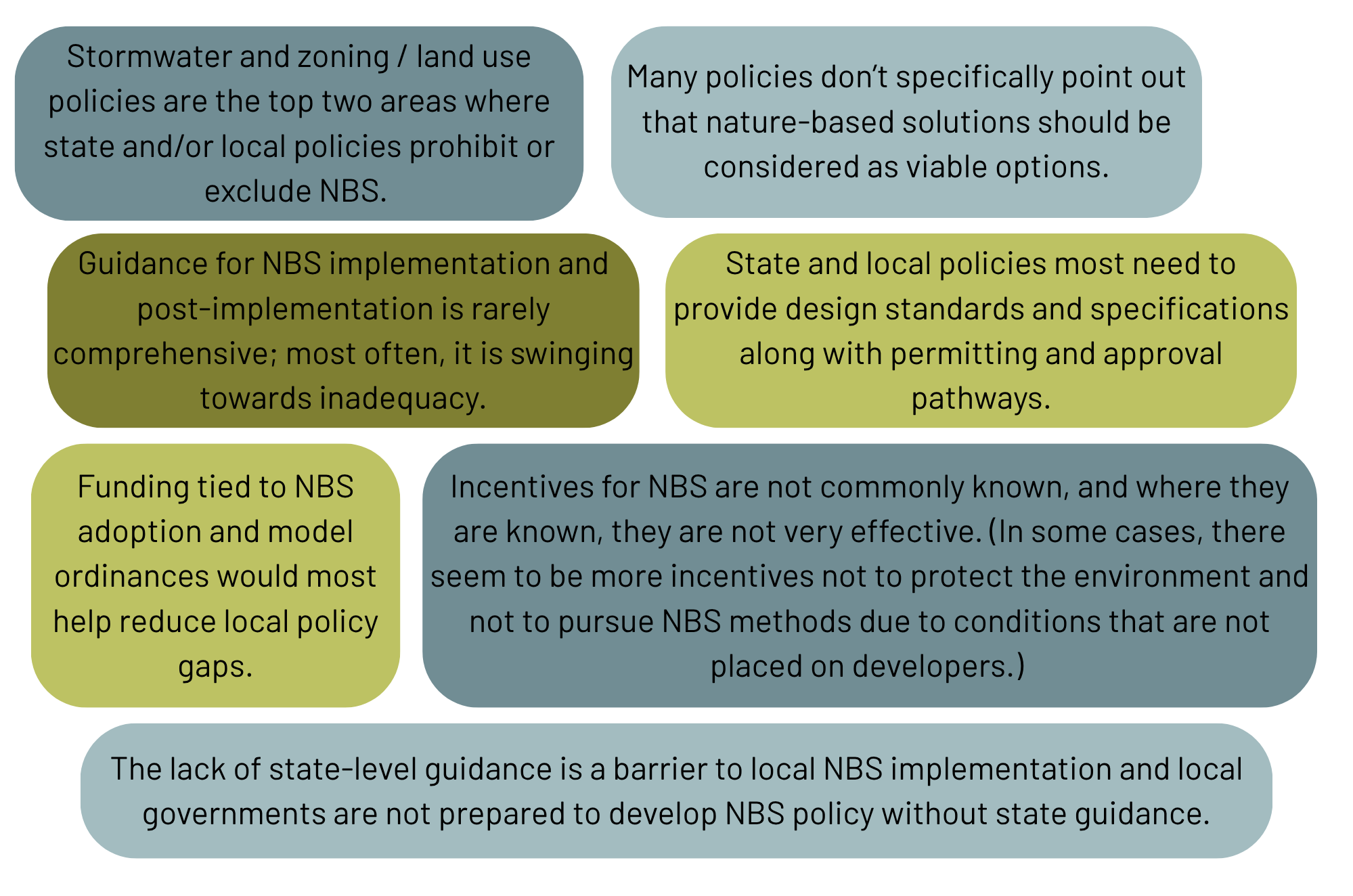
In April 2026, the Nature-Based Exchange sent out a survey to our listserv in the hope of gaining a clearer understanding of where and how policy is limiting nature-based projects in South Carolina.
What we learned: Good things are happening as updated policies are allowing, encouraging, and sometimes even incentivizing nature-based solutions at the local level and the South Carolina Office of Resilience (SCOR) is working hard to move the needle at the state level. But more policy change is needed in order for nature-based solutions to be implemented at a faster rate and at a larger scale.
A summary of key findings from the survey can be found to the right.
Based on the feedback from the survey, we have created a list of common nature-based solutions and examples of code and model ordinances that encourage their adoption and implementation. Check out the downloadable PDF or scroll down to learn more.
Nature-Based Solution
Model Ordinances & Legislation
Updated September 2026
Municipal governments are often vested with the primary authority to regulate land use and development, and their laws, plans, and policies can either encourage or dissuade the implementation of resilient and nature-based solutions in addressing infrastructure needs.
Nature-based solutions are diverse—there is no one-size-fits-all approach to their adoption, and community needs and regulatory structures differ across jurisdictions. Therefore, regulations and policies designed to encourage the implementation of nature-based solutions need to be similarly tailored on a community-by-community basis.
We have listed common nature-based solutions and examples of code and model ordinances from municipalities and counties, organizations, and state and federal agencies across South Carolina and beyond that encourage their adoption and implementation. Our purpose in compiling this list is not to be prescriptive, but rather to provide a repository of statutory measures that individuals, organizations, and governments can use as references when considering how to advance nature-based solutions in the cities, towns, and counties where they work and live.
Flood Resilient Development
Although all these examples are not necessarily nature-based solutions, they establish the regulatory and planning foundation upon which nature-based approaches can be built. Sound floodplain management and resilient development standards help communities reduce risk today while creating opportunities to integrate nature-based solutions into future planning, infrastructure, and land-use decisions.
US FEMA Model Flood Resiliency Ordinances (landing page linked here)
Version One (Recommended if Chapter 1 of the I-Codes is adopted and IBC Appendix G is adopted.)
Version Two (Recommended if Chapter 1 of the I-Codes is adopted and IBC Appendix G is not adopted.)
Version Three (Recommended if Chapter 1 of the I-Codes is not adopted and IBC Appendix G is not adopted.)
Georgia DNR Coastal Resiliency Guide Model Flood Resilient Development and Building Ordinance (see appendix A, page 86)
City of Charleston Flood Hazard Prevention and Control Ordinance
City of Charleston Ordinance to Prohibit Slab-on-Grade Foundations in the 100-year Floodplain
Town of Mount Pleasant Flood Zone and Flood Ordinance
Town of Hilton Head Flood-Resistant Construction Requirements
Stormwater
Stormwater ordinances are among the most direct ways communities can implement nature-based solutions. By encouraging practices such as rain gardens, bioswales, permeable surfaces, urban trees, and other low impact development techniques, these regulations can reduce flooding, improve water quality, and provide habitat and community benefits. Stormwater ordinances can also establish funding mechanisms, such as utility fees, to support the implementation and long-term maintenance of nature-based infrastructure.
Georgia DNR Coastal Resiliency Guide Model Stormwater Resilience Ordinance (see appendix A, page 89)
Low Impact Development in Coastal South Carolina: a Planning and Design Guide (2014): A comprehensive manual on implementing low impact development practices, providing engineering tools, planning guidance, and case study examples that are relevant to the South Carolina coastal zone. The City of Charleston’s Stormwater Design Standards Manual 2020 revisions provide information that supports the implementation of an integrated, green infrastructure-based approach to natural resource protection, stormwater management, and site design that can be used to protect the City of Charleston’s and coastal South Carolina’s valuable natural resources from the negative impacts of land development and nonpoint source pollution.
The Southern Lowcountry Stormwater Ordinance and subsequent Design Manual is a unified, regional regulatory framework established to manage post-construction stormwater runoff quality and quantity. It outlines many stormwater BMPs. Beaufort County, Jasper County, and towns of Bluffton, Beaufort, Hardeeville, and Port Royal are all participants in the framework.
Charleston County code sec. 7.5-75 establishes as a purpose of its stormwater management functions “to control the potential adverse effects of increased stormwater runoff and related pollutant loads associated with both future development and existing developed land.”
Stormwater Utility Fees:
City of Columbia: See city code Article VII, Sec. 23-200 – 206 for regulations pertaining to stormwater utility fees.
City of Charleston levies a stormwater fee of $132 per year per 2,200 square feet of impervious area as established by code section 27-140.
Greenville County assesses residential and nonresidential stormwater fees based on impervious surface area.
Parking Requirements:
City of Greenville code sec. 19-6.1.6 requires that all parking areas exceeding the minimum parking space allotment implement low impact development techniques, including but not limited to bioretention areas and vegetative strips. Fee-in Lieu of LID provided as an option for developers as well.
Town of Mount Pleasant code § 156.992 Landscape Design provides that in and around parking areas and other commercial development “the use of bio-swales, rain gardens, and other low impact development (LID) features in required landscape areas is allowed and encouraged.”
Town of Summerville Unified Development Ordinance sec 7.6.2 provides that “Parking areas may be organized to provide consolidated landscape areas as opportunities for passive stormwater management including bioretention areas where practical.” An example design of a bioretention area is provided in the code.
Impervious Surface Limits:
Town of Sullivan’s Island Impervious Coverage Restrictions (sect. 21-26 of Sullivan’s Island Zoning Ordinance)
City of Austin, TX, “Save Our Springs” regulations (code § 25-8-514) limit impervious surface and provides other watershed protections in the Barton Springs priority watershed.
Anne Arundel County, MD code § 17-8-402. Caps impervious surface allowances in Critical Area designations.
Sea Level Rise, Coastal Flooding, and Shoreline Stabilization
Planning for sea level rise and coastal flooding is essential to reducing long-term risk to communities, infrastructure, and natural resources. Local plans, policies, and ordinances can help communities anticipate future conditions, guide development away from vulnerable areas, and support adaptation strategies. Nature-based solutions, including living shorelines, dunes , and other natural coastal features, can play an important role in reducing erosion, managing flood impacts, and enhancing ecosystem resilience while providing multiple environmental and community benefits.
Georgia DNR Coastal Resiliency Guide Model Sea Level Rise & Tidal Flooding Resilience Ordinances (see appendix A, pages 93 & 96, respectively).
City of Charleston Comprehensive Flooding and Sea Level Rise Strategy
Shoreline stabilization:
SCDES Living Shoreline page
University of Georgia Institute for Resilient Infrastructure Systems Overview of Living Shoreline Permitting and Regulatory Review (across several Southeastern states)
Dune Protections:
City of Folly Beach code § 151.02 makes it unlawful to damage, destroy, alter, level or remove any sand dune or any part thereof within the city, or any vegetation, shrubbery, trees on the sand dune or beaches within the city. Code § 151.03 further makes it unlawful for any person to cut, break or otherwise destroy sea oat plants or any part thereof on public or private property within the city.
Town of Hilton Head code sec. Sec. 8-1-411 makes it unlawful to alter, destroy or remove any portion of a sand dune without a permit. Sec. 8-1-413 further makes it unlawful for any person to alter, remove or otherwise destroy sea oats or any other vegetative matter growing out of the sand dunes (with the exception of permitted elevated dune walkovers or similar beach access).
City of Myrtle Beach code sec. 5-22 makes it unlawful for any person to destroy, mutilate, break, move, tear up, carry away or alter in any manner the sea oats, beach grass, other beach vegetation, sand fencing, public access structures, public beach structures, or fixtures occurring naturally or planted or erected by the government or its agents as part of any beach re-nourishment or preservation.
Buffers and Non-Navigable Wetland Protections
Buffer and wetland protection ordinances help preserve natural areas that filter pollutants, absorb floodwaters, stabilize shorelines, and provide wildlife habitat. These regulations can further support nature-based solutions by encouraging the use of native vegetation within buffers, restoration projects, and development practices that maintain or enhance natural ecosystem functions.
Buffers:
City of Savannah, GA code Chapter 3 Article 9 sec 9.5 establishes the purposes of and regulations for vegetative screening and buffers.
Town Summerville Unified Development Ordinance sec. 8.6 mandates screening and buffers between development sites.
York County code sec. § 155.584 provides that native shrubs be planted in required buffers around solar energy facilities.
Oconee County code sec. 38-11.1 establishes a natural vegetative buffer for waterfront parcels along lakes Keowee and Jocassee; the buffer extends 25 feet from the full pond contour.
Greenville County Riparian Buffer Design and Maintenance Manual
Town of Hilton Head code sec. 16-6-102.D.2 establishes buffers for tidal and freshwater wetlands.
Wetland Protections:
The South Carolina Environmental Law Project has a model ordinance available upon request at their website.
Town of Awendaw Wetlands Ordinance.
Town of Bluffton Wetlands Ordinance.
Georgetown County Wetlands Ordinance.
Vegetation
Vegetation ordinances help conserve and restore the natural landscapes that support water quality, wildlife habitat, flood mitigation, erosion control, and community resilience. Incorporating native plant requirements or incentives can improve the effectiveness, resilience, and ecological value of protected areas, while tree preservation, landscaping, and revegetation standards can help maintain ecosystem functions as communities grow and develop. Well-designed vegetation ordinances can also reduce maintenance needs, support pollinators and other wildlife, and strengthen the long-term performance of nature-based solutions.
Town of Hilton Head code sec. 16-5-115 (C.) establishes that subdivision layout shall be determined by a complete site analysis, and streets and lots shall be designed to preserve significant trees, stands of trees and understory vegetation and situated to minimize alteration of natural and historic site features.
Town of Hilton Head code sec. 16-6-102.E.5 provides direction on wetland revegetation for wetland mitigation projects, mandating the use of native plant species.
Charleston county zoning code requires native and naturalized species to be planted on landscape and buffer areas in certain zoning districts; see sections 4.24.8, §5.5.15, and §6.4.50.
Town of Kiawah Island code sec. 12-129 provides tree preservation statutes, with specific protections for native tree species and regulations encouraging the planting of native species.
Town of Mount Pleasant code sec. § 156.705 establishes tree protection zones.
Town of Sullivan’s Island code ARTICLE XVII establishes regulations on what trees can be removed without a permit and a Tree Commission to administer tree protection permitting and enforcement. See also the town’s Native Tree Guide.
Greenville County code ARTICLE IV: TREE STANDARDS AND PRACTICES encourages the protection of trees in new developments, particularly through the establishment of Tree Protection Plans.
Transportation and Rights-of-Ways
Transportation corridors and rights-of-way present significant opportunities to incorporate nature-based solutions into everyday public infrastructure. Through policies, design standards, and capital planning, communities can integrate street trees, bioswales, vegetated medians, rain gardens, and other green infrastructure into roadways and public spaces. These practices can reduce stormwater runoff, improve water quality, mitigate urban heat, enhance habitat connectivity, and improve community livability while increasing the resilience of transportation networks to flooding and other environmental hazards.
The EPA’s Green Streets Handbook provides specifications on numerous nature-based approaches to road design; chapter three outlines how states and local governments can establish green street programs.
The Federal Highway Administration’s Nature-based Resilience for Coastal Highways: FHWA produced research and technical assistance that enables transportation agencies to use natural and nature-based features to improve the resilience of transportation systems. FHWA sponsored five pilot projects, developed a white paper, regional peer exchanges, and an implementation guide.
Dorchester County Complete Streets Ordinance provides comprehensive planning for street design, including consideration of pedestrian and bicycle connections and tree planting.
Roadside infiltration swales:
The City of Charleston Stormwater Designs Standards Manual recognizes vegetated swales, bioswales, and other natural infiltration practices as BMPs for managing runoff and water quality (see pages 63-64, 80, 103).
The Greenville County Stormwater Management Design Manual has a chapter dedicated to Low Impact Development; section 10.3 encourages the use of swales for water quality and flood control purposes.
Anderson County Bioswale Technical Specifications.
Local Conservation Funding
Dedicated local conservation funding programs provide communities with the financial resources needed to protect and restore the natural assets that underpin many nature-based solutions. Through mechanisms such as greenbelt programs, greenspace funds, and voter-approved funding initiatives, local governments can conserve wetlands, forests, floodplains, working lands, and other natural areas that reduce flood risk, improve water quality, support wildlife habitat, and enhance community resilience.
Charleston County Greenbelt Program: Ordinance and Comprehensive Plan.
Dorchester County Greenbelt Program: Ordinance and Master Plan.
Zoning for Agricultural and Conservation Land Uses
Agricultural and conservation zoning districts help protect the open spaces, working lands, forests, wetlands, and natural areas that provide many of the benefits associated with nature-based solutions. By maintaining appropriate development densities, directing growth to suitable locations, and preserving connected landscapes, these regulations can reduce development pressure on sensitive resources while supporting flood mitigation, water quality, habitat conservation, and community resilience. Conservation subdivision and open space development approaches can further balance growth and development needs by clustering development while permanently protecting significant natural areas and agricultural lands.
South Carolina Department of Environmental Services Model Conservation Subdivision/Open Space Development Ordinance
Town of Mount Pleasant Code § 156.036 establishes Rural Conservation Zoning Districts to limit development density and support agricultural needs.
York County Agricultural Conservation Zoning District: see Code Sections § 155.026 - 155.028
Georgetown County Conservation Preservation zoning district and Forest Agriculture zoning district.
Lexington County agricultural overlay zoning district expansion ordinance.
Edgefield County code sec. 24-29 establishes a Rural Agricultural zoning district.
Greenville County Voluntary Agricultural Preservation Districts. (More information found here.)
Greenville County Open Space Residential Development: see section 7:2 of Greenville County Zoning Ordinance. The purpose of the provision “is to provide a method of land development that permits variation in lot sizes without an increase in the overall density of population or development.”
Town of Awendaw code sec. § 153.001 provides zoning requirements to preserve the town’s rural character, natural and historical resources, and waterfront environment.